Friday, October 4, 2013

The Session #80: More Like a Correction

For this month's SessionDerek Harrison of "It's Not Just the Alcohol Talking" asks us weigh in our opinions on the prospect of a craft beer bubble.  It's a subject I looked at in detail in a previous post, where I came to a somewhat troubling conclusion that in not too distant future, much tougher times were clearly on the way for the craft brewing industry and my best guess was that a few hundred breweries were going to fail or otherwise cease operations.  Rather than just repost it, let me summarize the major points

1) Bubbles occur when there's too much supply and not enough demand for all the supply to be sold profitably.
A bubble is a pretty loose term for large scale market failure.  I've experience bubbles professionally in both fiber optics and solar panels, and in the United States, we all witnessed the "dot.com" bubble and the housing bubble.  Lots of people describe bubbles using a bunch of big words and technical jargon that sound deep and insightful, but bubbles really aren't that complicated.   Bubbles occur when too much supply is created in a market where there's not enough demand for all that supply to be sold profitably by most of the firms in the market.  While craft beer is growing fast, many breweries are involved in major expansions and over a thousand new breweries are in the planning stages.  Brewing requires large investments in equipment and material, so most breweries take out large loans to pay for start-up and expansion costs.  If all these breweries have trouble finding distribution channels in an increasingly crowded market to sell their beer, or have to highly discount prices leaving them with little or no profit, they could find themselves unable to pay off the loans and may go out of business. 

2) Everyone focuses on the new breweries but established breweries are about to bring at least an extra 4 million barrels of annual capacity online by 2015.
All the new breweries being formed draw most of the attention when a craft beer bubble is considered, but no one seems to pay too much the large expansions taking place within the industry.   Simply counting from press releases and making reasonable and conservative estimates, I find at least  an additional 4 million barrels of annual capacity is about to come on line.  This includes Lagunitas, Anchor Brewing, Sierra Nevada, and New Belgium building second breweries and major expansions from breweries like Deschutes, Boulevard Brewing, Dogfish Head and Bell's.  There are numerous monthly press releases from various smaller breweries breathlessly announcing expansion plans and major distribution deals. 

So what?  Well, according to the Brewer's Association, craft beer sales for the first half of 2013 were 7.3 million barrels. If we simply double that number, that means at least 14.3 million barrels of craft beer will be sold this year.   If we compound that number for 2014 and 2015 at craft beer's currently astonishing growth rate at 15%, that means there will be an additional 4,700,000 million barrels sound in 2015 over 2013. 

That means the current 1,605 breweries the Brewer's Association says are in the planning stages will be fighting over the sales of the remaining 700,000 barrels of beer, which works out to 436 barrels per brewery, or a little less than the size that a small brewpub.  Which suggests if you plan to open a small brewpub, there will probably be a place for you.  However, any brewery with ambitions of becoming a regional brewery pumping even smallish 1,000-3,000 barrels of beer each year is facing some very long odds.

It's also important to add I haven't included so-called crafty brewers like Goose Island or the Craft Brewers Alliance in this analysis, since they are not included in the statistics of the Brewer's Association.  Needless to say, they make the situation for any aspiring craft brewer worse since Goose Island is in the midst of a nationwide rollout as Anheuser-Busch transitions their Budweiser facilities to produce more Goose Island.  The Craft Brewer's Alliance recently announced a brewery expansion of nearly 150,000 barrels annually as well.
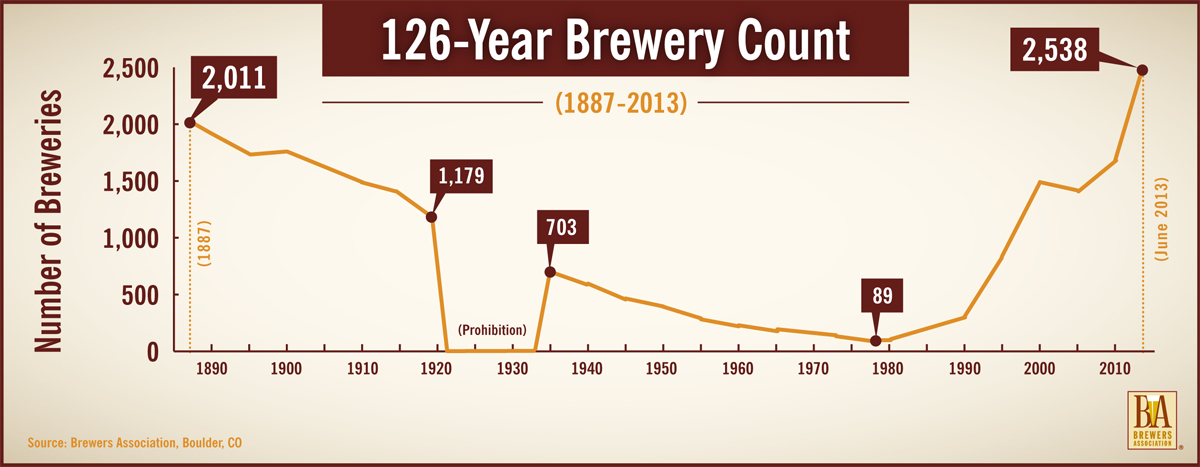
Can this astonishing growth of breweries continue? 


3) If the Growth of Craft Beer Slows to 5% or even 10%, a lot of breweries are going to fail despite this high level of growth.

I have seen and heard numerous comments assuring everyone that craft beer won't experience a bubble because it will continue grow.  While it certainly true that craft beer is growing and is currently humming along at a 15% a year pace, it's an open question if this high growth rate is sustainable for the next 2-3 years at least.  Because if this 15% growth rate is not maintained, a lot of breweries are going to find themselves is seriously difficult position.

To understand this, consider various rates of growth of the craft beer industry from 5-15% over the next two years and how that will affect the demand over the next two years, assuming 14.6 million barrels of craft beer sold in 2013.

Growth rate in      2014                        2015                      Difference between 2013 and 2015  Sales
                                15%                        15%                       4,700,000
                                15%                        10%                       3,900,000
                                15%                          5%                       3,000,000
                                10%                         10%                      3,100,000
                                10%                           5%                      2,300,000
                                  5%                           5%                      1,500,000


Based on at least 4,000,000 barrels of annual capacity coming online during this period from currently existing breweries, we see that only under 15%-15% scenario will this demand exceed what is already coming online by existing breweries.  Under any other growth scenario, it becomes clear that way too many breweries will be producing too much craft beer that can be sold.  Some breweries will muddle through this, others with strained fiances, questionable business strategies, or simply mediocre products will face tough times and likely fail.  In addition, many new breweries are founded by smart, ambitious 20 and 30 somethings that may find eking out a living with a small brewery struggling in a saturated market is not what they signed up for and fold up their operations for greener pastures.

Yes, it is certainly possible that craft beer industry could grow by 20%.  That would be an unprecedented growth rate for a mature product like craft beer, which has been around for decades, and craft beer has never experienced anything close to 20% growth in any year.  It's just not likely to happen.


4) So what do I think will happen?

I see the craft brewing industry going through a similar pattern to bubbles past, with many new entrants and over expansion in a rapidly growing market to the point where it becomes over saturated and only the strongest firms can survive.  But unlike the dot.com, fiber optic, or solar panel bubble I'm familiar with,  I don't expect the majority of the businesses to fail.  Established breweries like Stone Brewing, Sierra Nevada, or New Belgium should do fine.  The current rate of failures in the craft brewing industry is currently absurdly low,  around 40 a year, or 1-2%.

Talk to people in the craft brewing industry, and you'll find them conceding a shake-out or consolidation is on the horizon. In fact, what I've basically done is express in numbers the gut feeling many in the industry have.  So it's pretty realistic to expect a few hundred breweries failing as the market reaches equilibrium.  There is little doubt in my mind we are headed towards a market correction of this magnitude.


Thursday, October 3, 2013

The Hermitage Brewing Fall Beer Trifecta

From left to right Oktoberfest, Burn's Bitter, and Fruit Crate Pumpkin Ale
Fall is my favorite season, it's crisp cool days making for perfect running weather.   Fall is also the time most breweries put out their fall beers, traditional malt forward beers with a toasty and caramel flavors and low hop profiles to capture the flavors of the season.   Being a malt forward kind of guy, I tend to be a big fan of fall beers.  Wouldn't you know, South Bay's Hermitage Brewing is putting out three new fall beers, and gave me a chance to try them over at their brewery.   I ran into one of my beer blogging inspirations, Hermitage Brand Manager Peter Estaniel at the brewery tap room who gave me the low down on the beers.   So without any further ado, let's delve into these fall offerings.


Burnes' Bitter
The Burnes' Bitter, is well, bitter.  It's got a crisp, clear underlying malt and as Peter explained, "all the hops in this beer come from the UK."  I found the bitterness more herbal and tea-like as typical in British beers, without the spicy or fruity character other hops might bring to the brew.  At 4.5% abv with it's palate cleansing bitterness, it worked quite nicely as a session beer.

Oktoberfest
Traditional Oktoberfest's are light lagered beers that are a little toasty or caramel with a light hop character specifically designed for large scale consumption in the traditional beer orgy that is Oktoberfest.  This is not your traditional Oktoberfest beer, and that's a good thing.  Hermitage uses Common Yeast which gives it a musty character, the requisite toasted malt, and healthy doses of hops that lend a fruity character and more bitter finish to the brew that is far bigger, stronger and more complex than a traditional Oktoberfest.  Call it a "West Coast Oktoberfest" and while purists may cringe, enjoyable and memorable brew.

Fruit Crate Pumpkin Ale
And now we get to the star of the show, Fruit Crate Pumpkin Ale.  As Peter described, "we took a bunch of organic heirloom pumpkins grown on a nearby farm, then roasted them at the brewery, then ground them up and added them to the brew kettle.  The yeast ferments out of lot of the sugar so it has a little different taste them people might associate with pumpkin".    Unlike many other breweries, Hermitage doesn't add any additional spices to their pumpkin beer.  The base beer is best described as an Imperial Red, very smooth, malty and a little caramelly with low additions of hops to let the pumpkin flavor shine through.  The pumpkin is pretty subtle, and gives the resulting brew a nice twist. Peter found the pumpkin to get the brew a little vegetable like finish, which I also noticed.  At 9% abv, it's works really well as an fall afternoon or evening sipping beer.

Organic Heirloom Pumpkins for the Fruit Crate
Pumpkin Ale Roasting Away (Photo from Hermitage Brewing)


Thursday, September 26, 2013

Smoke Eaters in Santa Clara: Further evidence the good guys have more work to do

I finally got a chance to check out Smoke Eaters, which recently opened a location in Santa Clara near where I work.  Located pretty much at ground zero of Silicon Valley tech industry, it's a place seemingly designed to capture the busy tech lunch crowd as well as being strategically located near the new San Francisco 49'ers Stadium to be completed next year.

Inside, it's a pretty typical sports bar with lots of flatscreen TV's and sports memorabilia on the walls with a pretty standard menu of wings, burgers and sandwiches.  But wow, there's got to be over 20 taps running across the back wall, with great local selections like Santa Clara Valley Brewing's Peralta Porter, some hard to find Stone Brewing selections, and lot's of other good brews from places like Ballast Point and Port Brewing.
 
There's just one problem.  The beer menu on a chalk board over the bar has, shall I say, some rather curious mistakes.  Now I can forgive Calicraft's Oaktown Brown Ale listed under the "Stouts/Porters" column.  But Redd's Apple Ale listed as a "Sour Ale"?  Ballast Point Longfin Lager listed under the generic heading of "Ales"?   I won't bore you with 2-3 other questionable menu listings I noticed.

Should I be thrilled that yet another establishment is bringing more great beer to the masses and simply overlook these grievous errors on the beer menu?  Well, perhaps.  But to this beer geek, these laughable misclassifications on the chalk board menu were as irritating as someone dragging their fingernails across it.    Maybe it's because not too many years ago, places with a tap list as extensive as Smoke Eaters were pretty dedicated to craft beer and a big part of their mission was educating the masses to look beyond light lagers.  Now Smoke Eaters could have simply listed their beers without any mention of style, and I'd be fine with that.  But calling a mass market cider a "Sour Ale" and other glaring mistakes shows all when it comes to beer, they really don't get it despite the impressive array of tap handles.

Beer deserves more respect than being a simple gimmick to bring in the crowds.   Here, beer seems  like window dressing like the framed autographed uniform of Howie Long hanging on the wall.  Perhaps there's someone in the Smoke Eaters organization who has a vision of what a good beer bar is supposed to be, but that vision isn't being executed very well on the restaurant floor.  I spoke to the bartender about the Redd's Apple Ale listed as a "Sour Ale", and he was pretty good natured about my admittedly snarky comments, but clearly didn't know what I was talking about.  The food was good, the staff was friendly, but no one seemed to know much about beer there.

Don't worry Smoke Eaters, someday I'll be back.  But is it possible you can fix the beer menu and get the staff up to speed on what beer is all about before then?

Tuesday, September 24, 2013

Little Lou's BBQ: Further Evidence the Good Guys are Winning

Sitting in a comfortably worn strip mall in Campbell between a frozen yogurt shop and a hair salon is Little Lou's BBQ.  From the outside, this modest and assuming place looks like one of those places you'd enter thinking "God, I hope they at least have Sam Adam's or Anchor Steam on tap".  Enter the place and surprise, they have a tap list of about 15 beers most hard core beer geeks have tried already, but it's solid with stuff like Calicraft's Buzzerkely, Allagash Black and Ballast Point Sculpin IPA.

It wasn't always this way.  When I first moved just a block away from the place about a year ago, they had maybe 4-5 selections including the obligatory Coors Light, Budweiser and yes, Anchor Steam.  As if they knew I had just moved in, they quickly added several taps and transformed into a pretty good place for this beer geek to hang out in.   The beer seems to have energized the place as they now have live music most evenings and crowds most evenings seem larger than I remembered when I first stepped into more tired looking place a year ago.   As for the food, where else besides California would traditional barbecue peacefully coexist with Vietnamese Pho' and Vermicelli dishes on the menu?  And I'm here to tell you the barbecue sandwiches are solid.

If I had my druthers, I'd prefer Little Lou's have a couple South Bay selections from Strike, Hermitage or Santa Clara Valley Brewing on tap.  That quibbling aside, if you'd want to witness the power of good beer, join me for a pint at Little Lou's.

Thursday, September 19, 2013

One of my Favorite Workouts: The Four Mile Track Tempo Run

These runners would be even faster if they did Four Mile Track Tempo Runs.
Today I'm going to tell you about one of my favorite workouts, the Four Mile Track Tempo Run. I started doing these runs over eight years ago with a loose collection of runners that gather at the Los Gatos High School Track Saturday mornings to do this workout with Brad Armstrong, Los Gatos running coach and owner of The Athletic Performance. The workout is pretty self explanatory. You run around the 400 meter track 16 times for a four mile run at tempo pace.

Now if running 16 laps around a track sounds a little tedious, that's partly the point of doing this. I find one of the hidden advantages of this workout is developing the mental focus and discipline required to keep knocking out lap after lap while keeping on a comfortably hard tempo run pace. And what's a good tempo pace for these workouts? You can use the Fancy schmancy tables established by coach Jack Daniel's. Daniels is the revolutionary coach who popularized the tempo run concept to increase the lactate threshold pace, the running speed at which the body starts producing energy anaerobically and generating leg-deadening lactic acid as a by-product of this anaerobic energy production.

Instead of using the tables, you can just do what I do and run at "hard to talk at more than a couple sentences pace". That's right, when I'm doing this workout, I can probably say a couple quick sentences to the person running next to me, but no more than that or I'd starting going into oxygen debt. I want to go out comfortably hard so I'm not gasping for breath the whole way, but if I could carry on a conversation with the person running next to me, I'm running too slow and missing out on the full training benefit.

The last six laps should be challenging to maintain pace, but not so challenging that it feels like a race effort. At the end, you should feel as if you could run at least another 2-3 laps if you had too. It takes a while to find the right pace, and the first couple times you do this workout, you may find yourself going out too fast and really struggling to maintain pace the last few laps. That's OK, since part of the workout is finding the right pace, and it's better to maintain pace for the whole four miles going a little slower than running the first couple miles fast and then dragging the rest of the way. The key to this workout is doing all four miles at the same comfortably hard pace and still being reasonably fresh the next day so your able to do at least a moderate workout the next day with no drop-off. If a four mile tempo run leaves you too tired to do anything but a few easy miles the next day, you've done it too hard.

I'll add that you'll want to be running at least 35 miles a week consistently before doing these workouts. If you're doing a little less weekly mileage that that, feel free to cut these runs back to 3 1/2 or 3 miles. Of course, you can also do these workouts on a running trail or other course other than a 400 meter track. Personally, I like doing this workout on a track because it's easier to make sure I'm keeping an even pace and while there is a certain monotony running 16 times around in a circle, part of the workout is developing the mental tenacity to overcome this monotony.

Of course, as your fitness level improves, you'll naturally find yourself running faster. Typically, you don't want to increase your pace more than about 5 seconds a mile every couple of weeks. It can be tempting to turn these workouts into race-like efforts, but avoid this temptation. Slow and gradual improvement as you keep an even pace over four miles for each tempo run provides best results.

The best thing about this workout is that I find it is great for preparing for a wide range of distances from 10k to the full marathon.   Currently, I'm doing these tempo runs bi-weekly with a training group on the Los Gatos Track Saturday mornings in training for the Monterey Bay Half-Marathon this coming November 17th. So far, these workouts are part of a steady weekly improvement as I ramp up my training for the big day. You never really know how things will go on race day, but by then I'll have several Four Mile Track Tempo Workouts under my belt, so I like my chances.


Los Gatos High School Track where I run the Four Mile Track
Tempo Runs. Of course, there aren't a bunch of people milling about
on the Saturday mornings when I do this workout.

Sunday, September 15, 2013

Answering the Burning Fall Racing Questions

No doubt you're all tossing and turning each night, unable to sleep wondering what races I'll be running this fall.  Well let me break that awesome suspense and tell you I've signed up for the Let's Go 510k, a 10k in Berkeley October 19th as a tune-up for the big "circle the calendar race", the Big Sur Half-Marathon on Monterey Bay this November 17th.  The Let's Go 510k runs around the Berkeley Marina and has a unique finish on the Golden Gate Fields Horse Race Track, the Big Sur Half-Marathon runs mostly along the Monterey Bay coastline, offering plenty of views of waves crashing into rocks in spectacular fashion.

I'm looking forward to the Let's Go 510k because I'm a big believer in a tune-up race 2-4 weeks before the big goal race.  Tune-up races serve as a reality check of how the training is really going,  and the Berkeley 10k should provide a means to establish a sensible opening pace for the Big Sur Half-Marathon.

So far, training for the Monterey Bay Half-Marathon is going well.  I'm up to about 45 miles a week, more than I was doing weekly in preparation for the Santa Cruz Half-Marathon I ran last April.   I'm still doing the Eric Orton core and form workouts and they continue to pay off in improved running efficiency and injury prevention.  I'm also doing a lot of tempo running, including the long distance tempo runs I wrote about previously to get ready.  Stay tuned, because I'll be writing about one of my favorite work-outs, the four mile track tempo run shortly.

Sure, I'll admit this is a pretty self-centered post with a very high density of self-referencing links.  But if I can't write about myself at least once in a while, what's the point of writing a blog?

Tuesday, September 10, 2013

Beer of the Month: Sante Adairius's Nonna's #4 Sour Brown Ale


Yes, I'm still on this Santa Cruz brewery kick.  Maybe I just have a fascination with that quirky city over the hill.  Or maybe it's because they make a lot of damn good beer down there.  Whatever the reason, our Beer of the Month hails from Sante Adairius Rustic Ales in Capitola. 

There's been enough buzz about Sainte Adairius since it was founded last year that it was getting increasingly embarrassing to admit I hadn't been there yet.  Of course, given that few breweries could live up to considerable hype over Sante Adairius, there was the fear the beer would be a let down when I finally got to taste what everyone's been raving about. 

The good news is that wasn't the case a couple weeks ago on a warm late summer afternoon when my wife and I strolled over to Sante Adairius tap room to find the place overflowing into the parking lot outside.  Everything we tried was pretty good to excellent and it's hard to pick a favorite when more than a couple of their beers made our eyes open real wide and made us exclaim "Wow!" 

But forced to choose, I'll take Nonna's #4 Sour Brown Ale.  A sour brown sounds like a bad batch of homebrew I once made, but the idea makes a lot of sense when you think about a Flander's Red Ale.  I loved the crisp, clean sourness with an underlying nuttiness to it.  It's a struggle to define how it tastes, but often great beers are the ones that aren't neatly broken down into flavor components. 

You can't go wrong with any of Sante Adairius's beers, but their 831 IPA is worth seeking out as well.  It's a balanced, dry, musty and herbaceous brew that's undeniably a tribute to the hop but it an way you've never tasted before.  And if you want to learn more about the brewery, check out this great interview from Beer Samizdat.