This article, co-written with Pete Gauvin originally appeared in Adventure Sports Journal.
Something new is showing up in backpacks, in mountain streams, on rafts, and even on the beach. It’s beer in cans brewed by local and regional craft breweries.
The great outdoors is often enjoyed with beer in a can, since cans are lighter than bottles, shattered glass is not a hazard, and empties can be crushed for easy transport out of the woods. Moreover, bottles are often prohibited at many outdoor locations. Plus, canned beer submerged in a cold mountain stream cools down much faster than bottles.
So craft beer in cans is good news for outdoor enthusiasts, an independent-minded crowd that generally appreciates quality local and regional brews with character over the mass-market swill from corporate breweries that sink more of their budgets into advertising than their product.
Craft brewers themselves are also enthusiastic about cans. Check out their websites and you’ll find plenty of feel-good statements about how cans are better for both the beer and the environment. Cans protect beer from oxygen and sunlight better than bottles, and are a more earth-friendly package because they are significantly lighter than glass (35% of the weight of a bottle of beer is the bottle itself), stack easily with less packaging, require less energy to transport, and are more efficiently recycled.
“I absolutely love the package. They’re like mini-kegs,“ gushes Sean Turner, owner of Mammoth Brewing Company in the resort town of Mammoth Lakes. The Eastern Sierra brewery, founded in 1995, started selling beer in cans four years ago, one of the first craft breweries to do so. “Everything out here is so outdoor oriented. We sell beer in cans to hikers, fishermen, boaters, and golfers,” says Turner, whose brewery cans three of its brews to satisfy a wide range of taste buds: Epic IPA, Golden Trout Pilsner, and Real McCoy Amber Ale.
North of San Francisco in Mendocino County there’s a similar new-found enthusiasm for aluminum pop-tops at Anderson Valley Brewing Company in Boonville. Brewmaster Fal Allen is encouraged by the new sales growth spurred by last year’s decision to release three of Anderson Valley’s more popular beers in cans: Boont Amber, Hop Ottin’ IPA and Summer Solstice Cerveza Crema.
“Canned beer is about 8% of our business and growing fast,” says Allen. “It used to be our canning line would run once or twice a week. Now it runs pretty much every day.”
While it turned out to be a good business decision, Anderson Valley Brewing, which generates 40% of its electricity from solar panels atop its brewery, was also highly motivated by the environmental benefits of cans. Cans are nearly 40% lighter to ship than bottles, greatly reducing fuel costs and their carbon footprint.
It’s been less than 10 years since Colorado’s Oskar Blues Brewery became the first U.S. craft brewery to can its product when it started hand-canning its Dale’s Pale Ale in 2002 — a hoppy, strong (6.5% ABV) and critically- acclaimed brew that no doubt shocked a few unsuspecting palates weaned on limp, watered-down, mass-market lagers.
Today, there are 117 craft breweries in the U.S. offering premium beer in cans, according to the Canned Beer Database at CraftCans.com. And more are hopping on the can wagon every month.
The First Canned-Beer Revolution
Of course, canned beer has been around for decades. The first canned beer was sold in 1935 by the Krueger Brewing Company of New Jersey, which canned Krueger’s Cream Ale and Krueger’s Finest Beer for distribution in the mid-Atlantic and Northeast. By the end of 1935, 36 breweries were using cans — which, interestingly, included Pabst Brewing, whose “PBR” in recent years has established itself as the unofficial value beer among the outdoor set.
The first cans were made from heavy- gauge steel. Aluminum cans didn’t debut until 1958.
Sounds pretty good. But such regional breweries like Krueger’s (sold in 1961) wouldn’t last in the face of competition from national breweries like Schlitz and Anheuser- Busch.
In following decades, corporate breweries with high-speed canning machines began to dominate the American beer market. Creativity, quality and distinctiveness suffered in the battle for market share and profits. In most cases, the resulting product from these corporate breweries was a thin, fizzy, watery brew with a slightly metallic taste.
As tastes evolved with the resurgence of American craft breweries in the ‘80s and ‘90s, canned beer was derided by beer enthusiasts as cheap, tasteless and decidedly low-brow. But for cans, it was guilt by association. They were unfairly judged for the character of their contents, rather than the quality of the container. And such perceptions die hard.
Indeed, for the craft-brewing community devoted to flavorful hand-crafted beers brewed in small batches, canned beer epitomized everything that was wrong with American brewing. Even when an inert water-based lining for aluminum cans was developed in the 1980s to help protect the contents from ever touching metal, canned beer could not shed its cheap and inferior reputation. The stigma persisted and was only enhanced as “micro-brewed beer” became widely available, all in bottles, initially.
Clearing the Bottleneck
So how did canned beer mature to become the new darling of craft brewers?
The unlikely transition was spurred by a micro brewery in Canada’s Yukon Territory and a small Canadian manufacturing company which stumbled onto canning beer like a bear on a backcountry campsite.
Virtually all beer in cans sold by craft breweries in North America is canned by equipment manufactured by Cask Brewing Systems out of Calgary. The company got its start selling on-premise brewing systems to small brew-it-yourself operations that allowed home brewers to come in and use the facilities to brew their own beer.
Problem was, these brewing hobbyists often poured their beer into used and poorly cleaned bottles, with the beer degrading quickly thereafter. So in 1999, Cask developed a simple manual canning system so all that homebrew didn’t get poured down the drain.
Shortly thereafter, the owners of Yukon Brewing, a craft brewery in Whitehorse, Yukon’s capital and largest city (pop. 20,500) …… a brewery “conceived like many Yukon babies — around a campfire on a canoe trip” …… recognized that about 60% of beer in the Yukon was sold in cans and wondered how they might be able to squeeze into that market.
As they looked around for canning equipment, everything they found was for large scale brewing operations dealing with far greater volumes than they could possibly brew and priced far higher than they could afford. Then they tripped upon Cask Brewing’s manual canning equipment and gave them a call.
“That’s when all the light bulbs went on around here,” recalls Jamie Gordon, a technical sales rep for Cask who’s been with the company for over 25 years. In 2001, Yukon Brewing bought Cask’s manual canning system and became the first North American small-scale brewery to sell beer in cans.
Seeing a market for small canning systems for the hundreds of small breweries then in existence, Cask Brewing Systems decided to market their system at the 2002 Craft Brewing Conference in Cleveland, hoping to make a big splash. The response went over like warm beer on a summer day.
“Everyone looked at us like we were crazy,” remembers Gordon, as negative perceptions of canned beer remained high. “One guy walked up, shook his head, and told us it was the stupidest thing he’d ever seen …… I’d like to know where that guy is now.” As the saying goes, all it takes is one — and others will follow. Perhaps no one knows this better than beer drinkers.
In this case, Oskar Blues from tiny Lyons, Colo., was looking for a way to distinguish itself from the numerous craft breweries dotting the Rocky Mountain landscape like 14,000-foot peaks, and was willing to make the leap. “We thought the idea of our big, luscious pale ale in a can was hilarious,” recalls founder Dale Katechis on the Oskar Blues website. “And it made our beer immensely portable for outdoor enjoyment.”
Only later would he and his crew discover the benefits of cans — such as better beer preservation, a lighter environmental footprint and lower shipping costs. Already a successful brewpub, Oskar Blues was mainly looking for a way to sell some extra beer. But so many campers bought Dale’s Pale Ale on their way to nearby Rocky Mountain National Park they soon automated their canning system to keep up with the unexpected demand.
Colorado’s dynamic craft brewing scene couldn’t help notice Oskar Blues’ success.
The market for canned beer for the active, outdoor-oriented consumer was no longer a secret. Coors Light wasn’t going to be the first option any more.
Fermenting Acceptance
Yet negative perceptions of canned beer continued to be hard to settle, even as more and more small breweries started selling beer in cans. In 2005 when San Francisco’s 21st Amendment Brewery decided to start selling beer to take home from their brewpub, Shaun O’Sullivan suggested to co-founder Nico Freccia to package it in cans.
“It seemed like the stupidest thing I ever heard of,” remembers Freccia, “until Shaun started explaining all the benefits of canning, and then it seemed like a no-brainer.”
Another regional brewery that rolled straight into cans is Reno’s Buckbean Brewing Company, started in 2008, which cans its Black Noddy Lager, Orange Blossom Ale and Tule Duck Red Ale.
Things really started to change when the major craft breweries got into the canning act.
In 2008, New Belgium Brewing released their nationally popular Fat Tire Amber Ale in cans. “Fat Tire in a can really validated everything we were doing,” says Mammoth Brewing’s Turner. “The negative perceptions are no longer an issue,” agrees 21st Amendment’s Freccia.
And if that validation isn’t enough to pop your bottle cap, word comes down the canning line that the most prominent and influential craft brewery in California, if not the nation, Sierra Nevada Brewing Company of Chico, plans to release its iconic Pale Ale and Torpedo India Pale Ale in cans by the end of the year.
“The number one reason we decided to do this was cans go where bottles can’t, especially on hiking trails, rafting, and other places people want to take them outdoors,” explains Bill Manley, Sierra Nevada’s spokesperson. “I’m really excited our beers are coming out in cans this year.”
One of the reasons Sierra Nevada — which founder Ken Grossman named after his favorite hiking destination — hasn’t joined the canned beer frenzy sooner is that they’ve been searching for a plastic lining for their cans that won’t absorb hop compounds over time, says Manley, which they believe they’ve now found.
For “malt forward” beers such as Fat Tire Amber Ale, which generates most of its flavor from roasted malts, absorption of hop compounds has little consequence. For Sierra Nevada’s Pale Ale and Torpedo IPA, with their distinctive hop flavors and aromas, preservation of the beer’s hop character is more essential.
Though it is now the sixth largest brewing company of any stripe in the U.S., Sierra Nevada remains an environmentally conscious, independently owned business. The brewery is powered by solar energy, operates its own water treatment plant, and is the largest buyer of organic hops in the U.S. For these reasons and others, it won the U.S. Environmental Protection Agency’s “Green Business of the Year” award in 2010. But it wasn’t going to jump into the canned beer fray just because cans are an arguably greener option without first assuring that its first priority, the quality of its beer, would not be compromised.
Just as with bottles, craft brewers realize that canned beers are only as good as the beer inside. The last thing they want is someone carrying a couple cans 10 miles into the backcountry only to be disappointed. For one, that person could be Ken Grossman.
Secondly, how far behind can freeze-dried beer be? Just tear open the foil pouch and add water. Suddenly hiking the PCT for weeks on end would appeal to a much wider audience, I’m guessing. Or perhaps not.
For the foreseeable future, though, it appears craft brewers will no longer be kicking the can down the road.
Thursday, September 8, 2011


Monday, September 5, 2011
Leisurely Labors
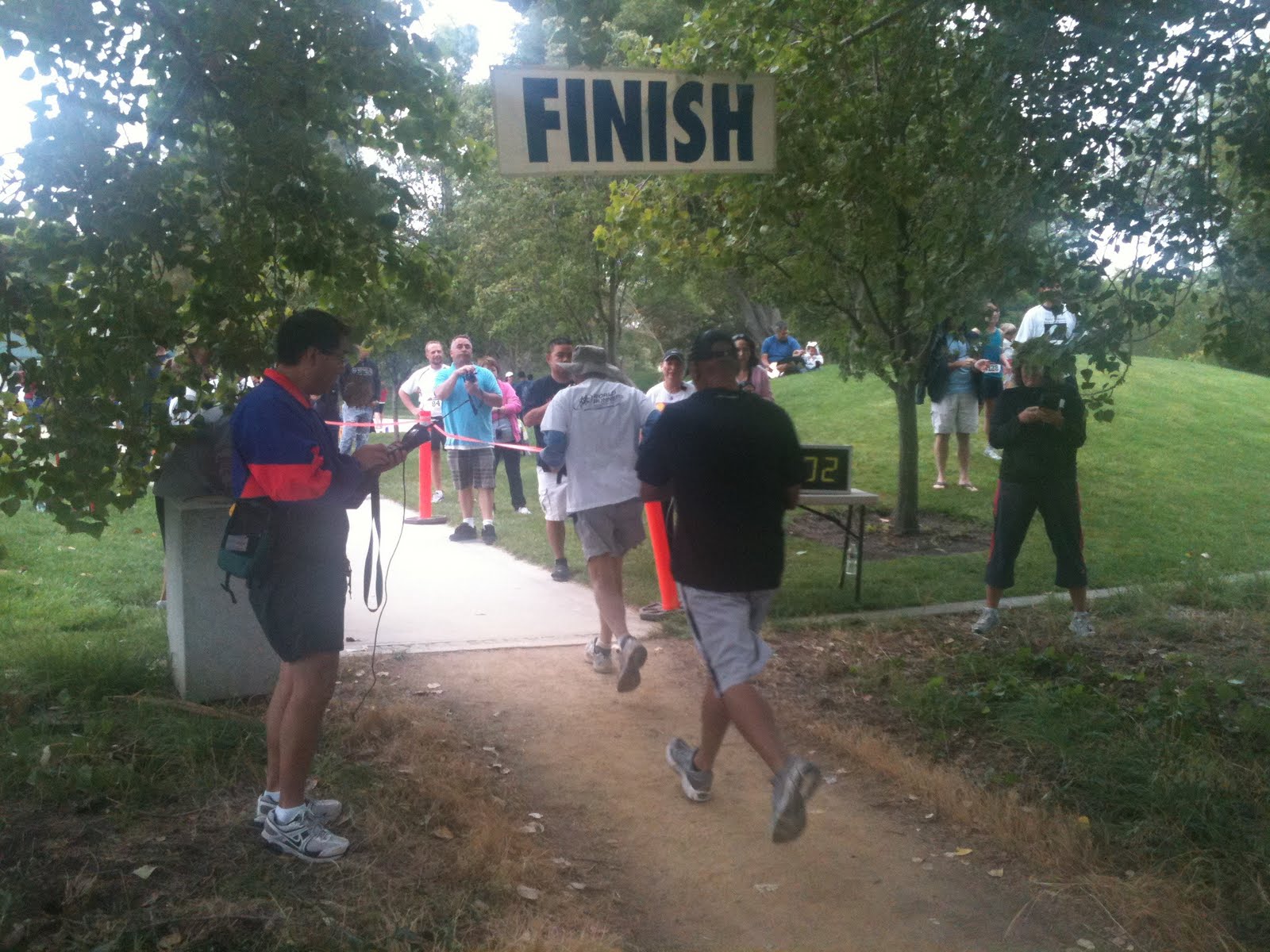 I guess there's little point in noting the oxymoron title of Labor Day, since it's a given few people work on it. Or if they do, it's work they've chosen willingly. Like a Labor Day morning 10k run.
If I had to describe how the race felt in a single word, it would be workman-like. (OK, that's two words connected by a hyphen.) World Runners, an organization trying to end world hunger put on the Labor Day race that morning in Sunnyvale Baylands Park was mostly on flat gravel trails, so there were no hills to contend with, but lots of soft crunchy gravel. In those conditions, best just to keep the arms moving, the legs churning, and work right through the course. I kept maintaining a steady pace, and passed a couple people at miles 2 and 3, but by the time I got to mile 4, it was one of those "the guy behind me isn't going to catch me, but the guy in front of me is too far away to get either" deals and so told myself to " just keep working" to get to the finish line. A 39:49 was slower than I expected to run, but then I didn't figure on being second master in the small race, so I guess I'll take that. I've got seven weeks of training to put in before the next race, the Grape Stomp Half-Marathon in Livermore. Not a lot of time, but enough to get some good runs in, get some extra tempo work on the track, and improve upon the Water to Wine Half-Marathon three weeks ago. (Why do I keep doing all these wine themed races?)
Speaking of Labor Day labors, I spent the afternoon brewing a Chile Habenero Stout. Yep, pretty ambitious to brew with chiles, especially since I'm having enough trouble brewing with malt and hops. But to my way of thinking, winging ingredients to come up with a unique, personally designed beer is a lot more fun than trying to perfect a Marzen, or copy beers already commercially available. Especially since the secret to homebrewing is spenign a lot of time cleaning a whole lot of stuff, which quite frankly, isn't a whole lot of fun, so you might as well have fun with flavors.
As for the stout, so far so good. Tasting the wort, the heat level was about where I wanted it, just a little noticeable, but not overpowering. The idea for this beer came from good Mexican chocolate, where there's plenty of flavors going on and little bite of heat at the end. That's what I'm hoping for anyway. Being a lot more confident I killed all the nasty bugs ruining my previous batches and rinsed the cleaning solution off the carboy that muddled the last brew, I'm feeling pretty confident about this one.
Brewing is a lot like running. Put in the well directed hard work and concentration and with a little patience, good things start happening.

Friday, September 2, 2011
The Session #55: Telling Us What's Inside
 For this month's Session Curtis Taylor of The HopHeadSaid asks us to write about our favorite beer labels.
The humble beer label must deliver so much. In a split second it has to win our attention from all the other labels fighting for it as our eyes quickly scan the shelf. Once the bottle is discarded, the best labels are easily remembered to do this job even more effectively the next time we glance in their direction. And while creating these impulses, the label must somehow visually convey the taste and feel of the beer in our throats.
I have zero artistic talent and know little about psychology, so don't have the foggiest notion of how this works.
But I'll take a stab at it. My favorite labels are not necessarily the most elegant, pleasing, or arresting artistic compositions, but those in their own unique unforgettable style leave me well prepared for what I'm about to drink. Don't ask me how these labels do it, they just do it. Look at two of my favorite recently released beer labels below. Which bottle do you think contains a celebration of bold aggressive flavors balanced on a razor's edge, and which holds a subtly complex combination of flavors mingling together from the farms of Sonoma County? It's obvious from the labels, right?

Wednesday, August 31, 2011
San Diego Truth in Advertising Part 3: The Beer Company
 Walking around downtown San Diego one night last week, looking for a place for, I spot a place on the corner called The Beer Company. It must have opened less than a year ago, since I didn't remember it being there last year. Intrigued, I walk in, sit down at the bar, and look at the list beer selections written on a chalk board, which consist of the usual Blond Ale/Pale Ale/IPA/Stout/Lager/Belgian Ale/ ect. tick list of styles. The interior is perfectly manicured light brown brick and mortar look, with fancy brass fixtures and an impressive looking stone bar table. I can't help notice all the young slender waitresses zipping around in tight black skirts with lacy trim.
One of the black skirts stops in front of me and asks "What'll you have?" Seeing me struggling to come to a decision, she tells me "You should get the sampler, that's what everyone gets."
I can't remember the last time I had a sampler flight at a brewpub, but it somehow makes sense and so order that. I then look around and see that nobody else is having a sampler flight.
I work through the sampler flight drinking one maddeningly competently brewed beer after another. Each beer is true to its style, and is creative and imaginative as The Beer Company's name. I silently hope one beer actually tastes bad just to break the monotony, but no such luck. Now I could see myself enjoying a pint of any of these beers, but just can't remember any of them. I order the grilled salmon, and when it arrives, it has this dill sauce on top that tastes great. Finally.
If anyone asks me about The Beer Company, I will say "They make beer."
Tuesday, August 30, 2011
San Diego Truth in Advertising Part 2: The Best Damn Beer Shop
 The Best Damn Beer Shop isn’t actually a stand alone beer shop, but simply the beer section in an otherwise slightly worn, nondescript grocery store on a quiet downtown street called Super Junior Market. But then, the beer section takes up one whole third of the grocery store.
I figured on finding plenty of great examples of San Diego County’s great brewing scene I can't get in Northern California after finding this place on an internet search. What I didn’t count was finding stuff from Oregon or even New Zealand I can't find anywhere else.
How this indescribeably expansive beer selection got here seemingly defies the laws of economics and even physics. I now have some idea how the people who first stumbled upon the Grand Canyon must have felt.
Monday, August 29, 2011
San Diego Truth in Advertising Part 1: Stone Brewing's Punishment
 I spent last week in San Diego at a trade show that I’ve been going to for years so by now I pretty much have the whole week's drill down. Monday is set-up day, and I fly in and help get things set-up in our booth at the exhibit hall and then go back to my hotel. Apparently, the beer gods were smiling on me when I made me hotel reservation on Priceline since of all the places that could have accepted my bid, it was at the Comfort Inn in the Gaslamp District almost directly across the street from one of the best beer bars in America, The Neighborhood, a bar full of artsy, counter culture décor including its trademark portrait of dreamily reverent of Jesus Christ about to bite into a hamburger.
I make my way to the Neighborhood in the early evening and they just starting to pour a new release from Stone Brewing called Punishment. Punishment is made with Stone's Double Bastard, their Imperial version of Arrogant Bastard which they then age in Oak Barrels, and then finally add a bunch of different chili peppers straight from owner Greg Koch’s backyard garden to it. My first reaction upon hearing how it was made was to completely avoid it, but as I quietly sipped a sweet and malty Hair of the Dog Adam, a nagging curiosity overcame my better judgment and I ordered it next.
At first sip, the beer has a wonderfully heavy, luxurious, apricot fruitiness mellowed by the smooth oak and then POW! the chili peppers kick in and overwhelm everything before slowly dissipating as the beer slides down the throat so you can repeat the same experience for the next sip.
This is not a beer you can really enjoy with food, or drink to unwind, but seems brewed merely for brewing sake. It is not a beer to be enjoyed, but to experience Stone masterfully manipulating strong flavors to simply to tease and trick you.
The next night, curiosity gets the better of me again, and I have another Punishment just to reaffirm my thoughts on this whole brewing exercise. I don’t want to have this beer a third time.
Thursday, August 18, 2011
The Power of Pace on a Beer Run in Sonoma Wine Country
 The big question in last weekend's Water to Wine Half Marathon held in Healdsburg, CA is "Was it worth it for Alderbrook Winery?". That's because Alderbrook hosted the post-race festivities which included free wine tasting, presumably to encourage many of the runners to actually purchase some of their wine. Perhaps this is news to Alder Brook, but most half-marathon finishers are fighting dehydration, have at least one body part hurting pretty bad, and often feel like puking. This is not an ideal time to be sipping a Chardonnay and appreciating its various subtle nuances and complexities, so you have to wonder how successful this little marketing idea was.
But hey, I've got to hand it to Alder Brook for putting on a good post-race show, with some tasty rice and beans on hand and a reggae singer so cool, polished and smooth, he could probably turn a Megadeath cover into a feel-good song you could grove to. And since my wife Linda and I wanted to help a race sponsor out and we liked Alderbrook's wines, we picked up three bottles the day before the race with our race packets. (I must admit to having an alter-ego that likes a good glass of wine from time to time.)
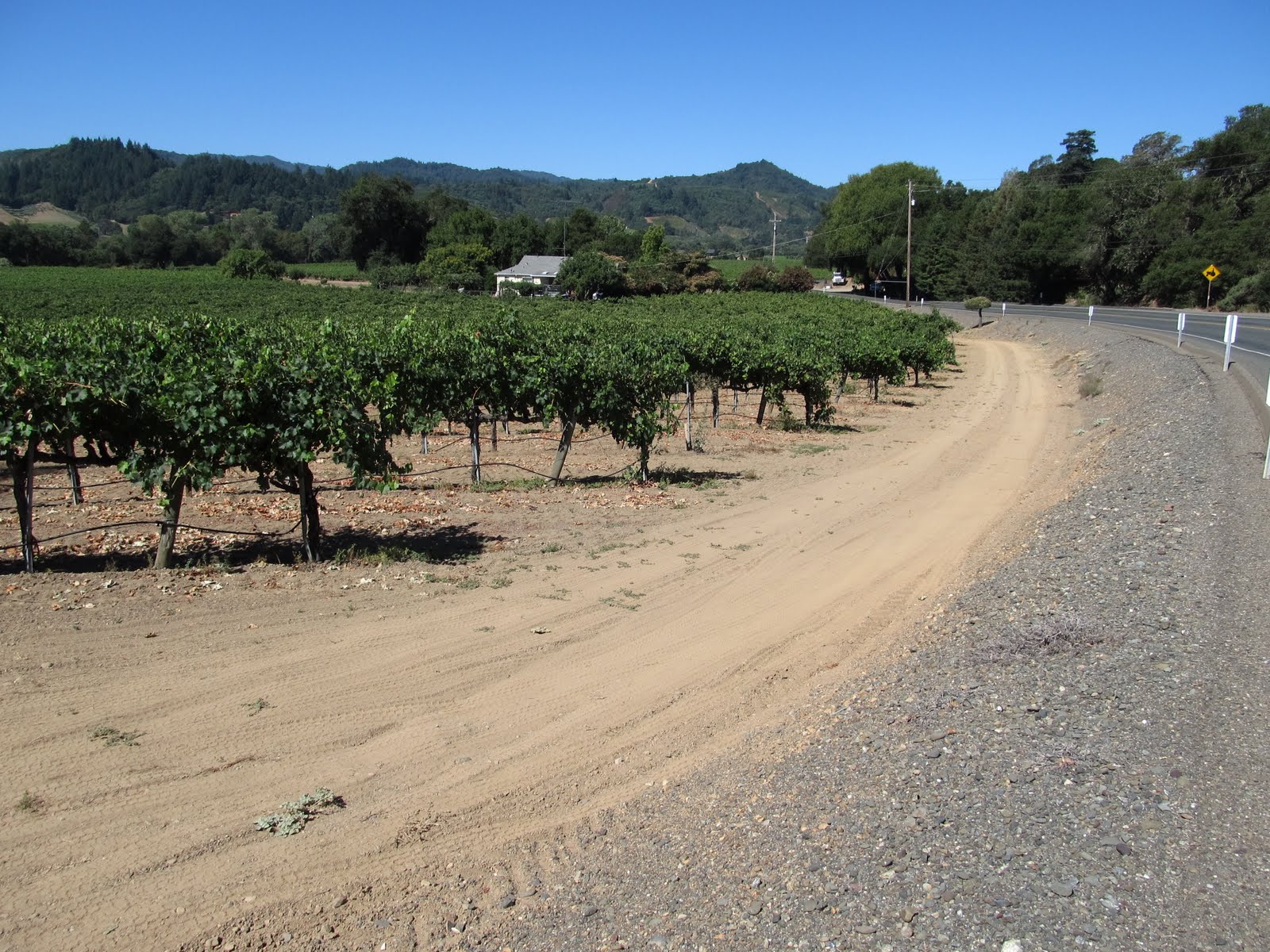
As for the race, it started at the base of Lake Sonoma dam and wound through picturesque country roads over gently rolling hills past several vineyards and wineries before finishing at Alderbrook just outside of Healdsburg, with a net elevation drop of 100 feet. After recovering from a bout with bursitis in April that knocked me out of the Santa Cruz Half Marathon, then going through a personally stressful period in June and July that affected my training. Having completed a number of runs of 7-12 miles around 7:00-7:10 minute per mile pace that were pretty challenging, I was just hoping to break 1:30, about 6:52 per mile pace.
The correct pace for a half-marathon based on fitness level is a deceptively comfortable one, and my biggest fear going into the race was going out at "only 6:40" pace, and then staggering in the last few miles. So the day before, I drove over my local high school track, and ran a 6:48 to get a get a good feel for target pace. At one point, I ever close my eyes while running, just to focus on rhythm and cadence. Then, I also did a few 40 yard stride-outs in my bare feet, which as I found out in a recent tempo work-out helped focus to form and kept my feet feeling fresh.
And wouldn't you know on race day, every time I looked down at my watch at each mile marker, I had just knocked out the last mile in 6:45-6:50 pace. By mile four, it was a little unreal, and I wondered if the mile markers were somehow wrong. No big hills certainly helped for uniform pacing, and I slowly marched through the field through miles 2 through 7, but after passing a guy struggling up a small incline, I could see no one ahead of me. I blitzed through downhill ninth mile in 6:36, but otherwise kept ticking off each mile in 6:45-6:50 even with no one in sight to run with. But since the course always went one way or another, or gradually up or down, the course itself gave me something to focus on.
I finally saw a couple runners way ahead of me at mile 11, and was reeling them in, but not fast enough before the race ended. I crossed the finish line in 1:28:41, which is 6:46 pace. One of the best paced races in my life and also one of the best times relative to my fitness. It's not a coincidence.
But the really big news was that Linda set her PR in 2:16:49, just under 10:30 mile pace, a pace not too long ago she couldn't maintain for a 10k. Was her PR due to good pacing as well? We'll never know for sure, since she can't exactly recall her mile split times, but she remembers her early miles just under 10:30 which is right where she should be. She undeniably earned her PR for all the hard work she put in weeks before the race, and she should be proud of what she accomplished, even if she keeps saying she runs like a turtle.
And with all due respect to all the excellent wineries in the area, the only proper way to celebrate Linda's half-marathon PR was with a few good beers. So we headed on over to Healdsburg's Bear Republic Brewing.

Bear Republic is best known for their Racer 5 IPA, the classic West Coast IPA where the hops dominate with the malt mostly an after thought. But go to the brewpub, and you'll get a much different appreciation for Bear Republic, where believe or not, the malt often takes center stage.
This was certainly evident in the first beer I tried, the Peter Brown Tribute Ale, named after a former sales manager for the brewery who passed away nine years ago. It was impressively clean and smooth, brewed with molasses and brown sugar that blended seemlessly with the light coffee flavors and nuttiness of the malt. And who says Bear Republic cannot make a balanced IPA, as Linda enjoyed their Endeavor IPA, with "only" 65 IBU's which had a lovely soft, biscuit-like, and lightly fruity hop character, which Linda and I prefer over Racer 5.
Speaking of Racer 5, they serve a Black IPA version of it here, called Black Racer, where the coffee-like like bitterness of the malt melds with the bitter hops creating a very bitter, yet mellow and easy drinking experience. Finally, Linda and I split a Racer 10, a Imperial IPA version of Racer 5 for "dessert". I'm beginning to appreciate why so many West Coast style IPA's taste even better in Imperial form, as the extra malt and associated sweetness just seemed to give the hops an extra juiciness and fullness.
So remember for your next race, conservatively figure out the right pace you should run, keep the mental discipline in the early miles to keep that pace, and fight like hell at the end. The beer will taste even better.
Subscribe to:
Posts (Atom)
-
I could wax philosophically about the egalitarian nature of both the sport of running and the beverage of beer. Or elucidate how a beer run ...
-
 As summer approaches, it's time once again to ramble on about a few beers which crossed my lips. I'll start with Debutante , a ...
 -
 Programming Note: This blog has moved and this will be the last post at this location. Please point your blog readers to the new site: ram...